

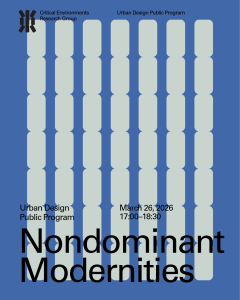
March 26, 17.00-18.30
Room BG OOST 620, Faculty of Architecture, TU Delft & Online (Register via link below)
What does it mean to be modern in the Global South, and who gets to decide? This event examines how large-scale modernization and extraction projects imposed from above were lived, contested, and reappropriated from below, drawing from cases in the Venezuelan Amazon and the Dutch Caribbean.
Situated at the intersection of urban history, decolonial theory, and spatial analysis, both contributions interrogate the material and social legacies of extractive and developmental capitalism across the Americas. Together, they respond to the Critical Environments platform’s effort to decenter urbanism from city-centric concerns and to confront the hidden externalities of dominant spatial development models – including those forms of extractivism, exploitation, and appropriation that persist long after formal colonialism ended. How does imposed modernity become lived modernity? What forms of resistance, negotiation, and hybrid world-making emerge in the face of spatial projects designed without, and often against, local communities? And what does it mean, from the Global South, to think otherwise about development, extraction, and the futures of landscapes still bearing their marks?
The Conquest of the South: Encountering development and modernity in the Casiquiare canal
Ricardo Avella is a Venezuelan architect, urbanist, and doctoral candidate at the Department of Urbanism at TU Delft. His doctoral research examines the modernization of the Venezuelan Amazon and the role of rural housing as an instrument of internal colonization during the Cold War. Funded by the Gerda Henkel Stiftung, his research offers a decolonial reading of this understudied historical moment through ethnographic methods and oral histories. By doing so, he explores how modernization theory, developmentalism, nation-building processes, indigenist and rural development policies, and public health discourses on tropical disease prophylaxis reshaped forests and rural territories across Venezuela during the second half of the twentieth century.
“Two Different Worlds”: The advent of corporate modernity in San Nicolaas, Aruba
Anna Karla de Almeida Milani is a Brazilian architect and urban historian, a Swiss National Science Foundation Postdoctoral Fellow at the Department of Urbanism of Delft University of Technology, and a Guest Lecturer at the Swiss Federal Institute of Technology Lausanne. Her current research, Flaring Oil in Paradise: Colonial Legacies of Company Towns in the Dutch Caribbean, extends this line of inquiry to oil refinery company towns in Aruba and Curaçao, examining how petroleum-driven urbanization shaped urban form, labor relations, and governance, and how colonial power structures were reconfigured rather than dismantled during the twentieth century. Her work draws on archival inquiry, microhistory, and spatial analysis to study the connections between architecture, labour, and biopolitics.
Critical Environments
This event is organized by Critical Environments, a platform that fosters intellectual exchange, collaborative knowledge production, and resource commoning. Hosted in the Section of Urban Design, Urbanism Department, the group brings design into dialogue with interdisciplinary perspectives from urban and landscape theory, critical media, and environmental studies.