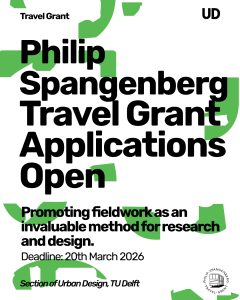
Deadline extended to the 27th of March 2026.
The Section of Urban Design at TU Delft organizes the Philip Spangenberg Travel Grant and book markets to promote fieldwork as a rich design and research method by financially supporting fieldwork for graduation students from any master track of the Faculty of Architecture and the Built Environment.
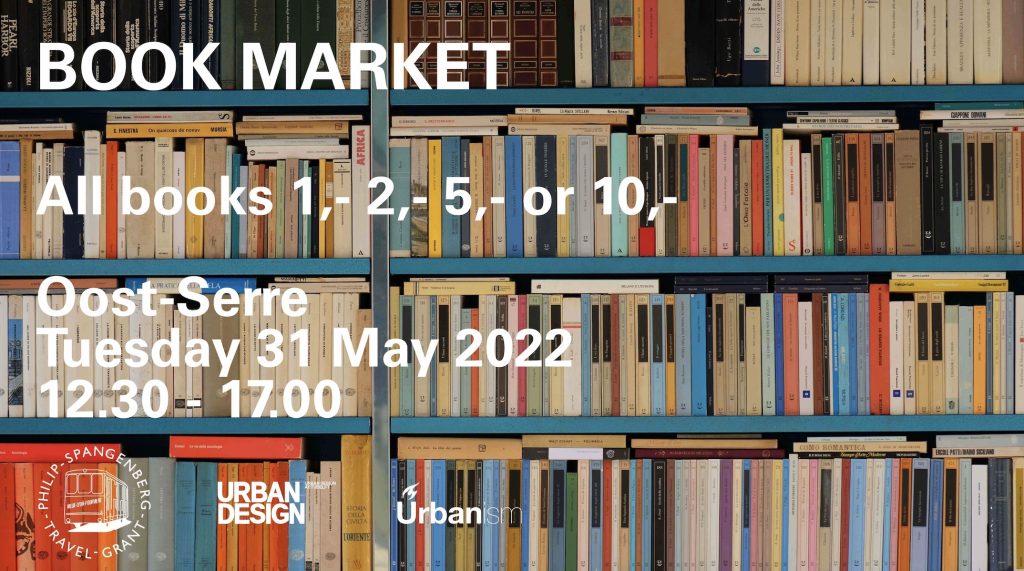
As such it connects to the legacy of Philip Spangenberg – urbanist and professional traveler – who, after his passing in 2009, donated his extensive book collection to the Urbanism department to replace much of the material lost in the 2008 fire in the old faculty building. The books that did not – physically and content-wise – fit the library were put up for sale in a book market in 2013 of which the proceeds laid the financial basis of the travel grant. Yearly book markets of subsequent donations from various individuals and institutions have strengthened these foundations. Please feel free to contact us for donations of any size of kind.
Application
Each year, graduation students of all tracks can apply to the fund by sending in an abstract of their graduation research, a letter of motivation elaborating on the role and method of field work, one image from the ongoing research, and a travel plan including travel dates, mode(s) of transportation, destinations, and field work activities. Deadline of the applications is usually around Christmas break (before or after) and will be announced by our website and social media.
The Philip Spangenberg Travel Grant aims to provide eight grants of 250 euros each. In this page you can find the pdf with the details of this year process. Reach out to Sahar Asadollahi Asl Zarkhah for details on this year’s edition of the travel grant.
In return, the fund collects one image per recipient of the grant, visualising their conducted fieldwork. This may be an illustration, collage, mapping, series of sections, video, accompanied by a short caption elaborating on the method of fieldwork in the graduation research and its role and value. Some of the submissions of previous years are exhibited below.
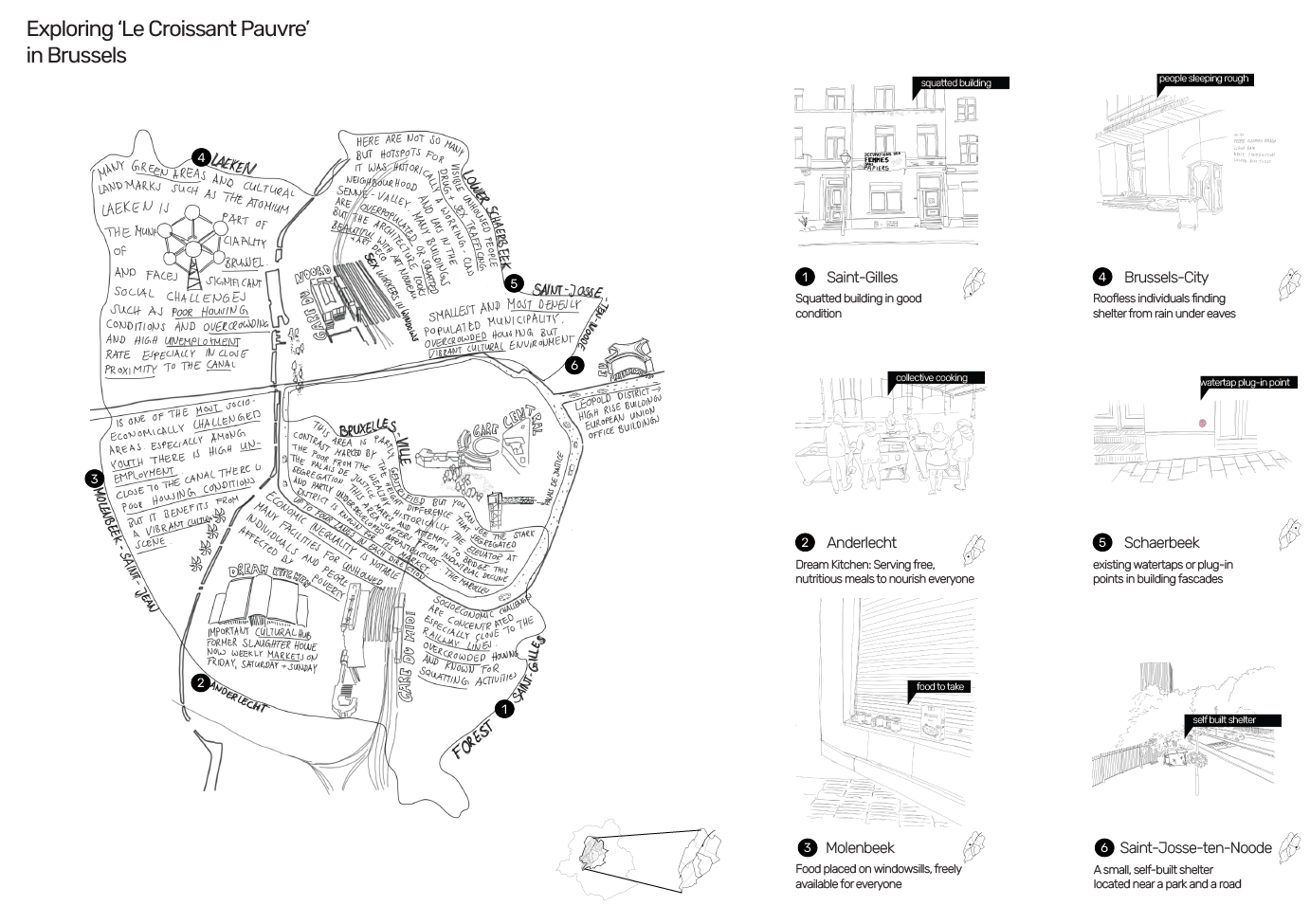
Through repeated fieldwork—walking, ethnographic mapping, and informal conversations—I sought to understand the socio-spatial patterns of resistance that reveal how young fluidly housed adults activate Brussels’ urban fabric to meet their needs.
Building on Lefebvre’s (1997) understanding of space as something both shaped by and shaping society, these observations uncovered the agency of this group in shaping their environment through responses born of necessity. As a result, these patterns of resistance helped me identify which socio-spatial conditions hold potential to be activated from the bottom up, informing design principles that shape the urban fabric more carefully—allowing it to adapt to changing needs and initiate a systemic shift that ‘hacks’ systems of marginalization from the ground up.
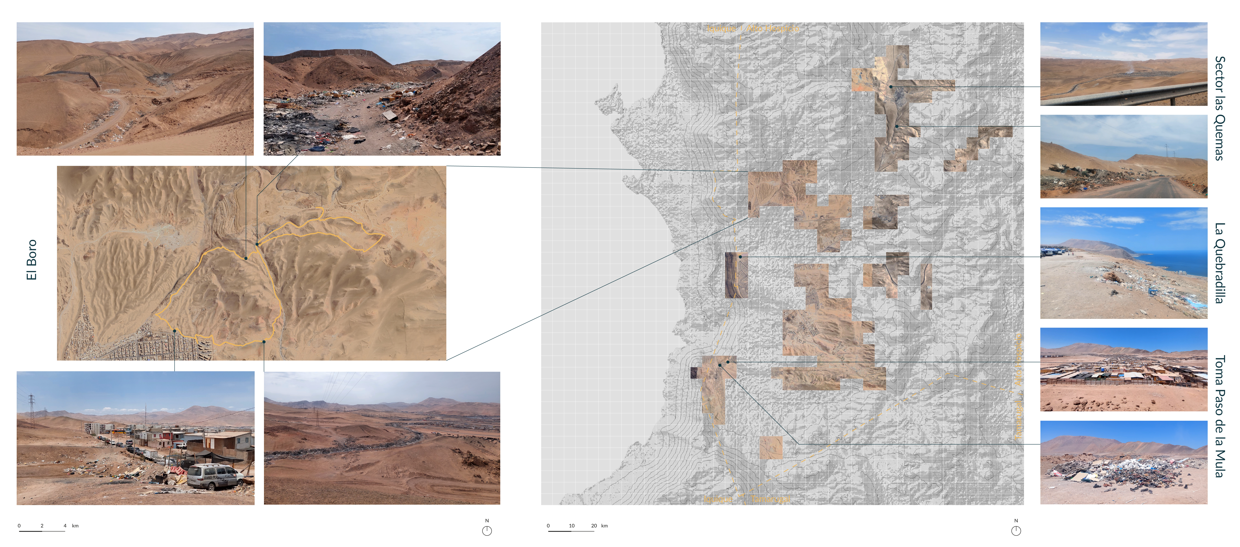
The Philip Spangenberg Travel Grant helped me visit Alto Hospicio and Iquique, an area in the north of Chile facing the problem of clandestine landfills spreading through the desert landscape. On these sites textile and other waste is being illegally discarded and even burnt contaminating the environment. A proposal to restore environmental justice in this area through a pattern language and design is the objective of my thesis. The fieldwork allowed me to observe and document local reality and talk to local experts about directions for solutions to the complex problem. The map on the right indicates areas affected by clandestine landfills. The map on the left highlights an exploration on foot through the hills just behind neighborhood El Boro, where the no longer operational municipal landfill is located.
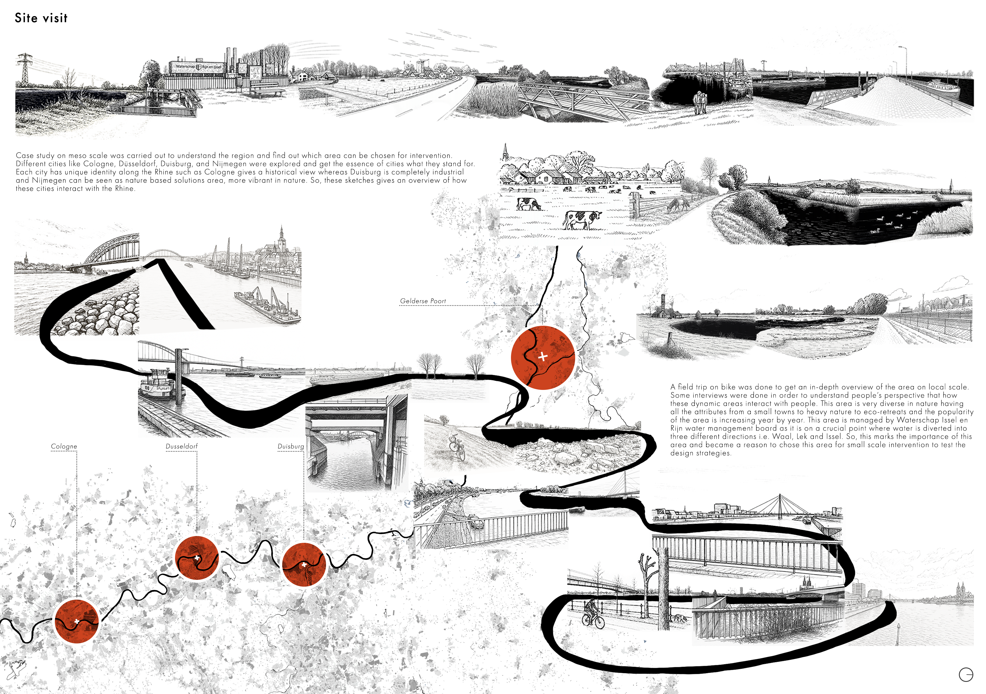
A multi-scalar fieldwork approach was adopted to ground the research in spatial and cultural reality. At the meso scale, site visits to Cologne, Düsseldorf, Duisburg, and Nijmegen captured the Rhine’s diverse identities from industrial infrastructure to ecological vibrancy. Sketches and observations revealed how each city engages uniquely with the Rhine. At the micro scale, a biking exploration of Gelderse Poort, combined with informal interviews, provided local insight into the area’s social-ecological dynamics. The site’s hydrological significance, managed by Waterschap Rijn en IJssel, and positioned at a key water diversion point, the site was selected as a strategic location to test and visualize design principles.